
How Japan Has Changed, as Told by a Japanese Woman in Her 50s (Part 2): The Employment Ice Age, Job Hunting as a Woman, and Long Hours as a Systems Engineer
 Keiko
Key points of this article
- After Japan's economic bubble burst in the 1990s, hiring of new graduates dropped sharply, and the period came to be called the "employment ice age". It was especially hard for women — far harder than for men.
- I got a job as a systems engineer, but more than 100 hours of overtime a month, unpaid overtime and paid leave you could never take were all considered normal.
- Workplaces like this were by no means unusual in Japan at the time.
What Was Japan's "Employment Ice Age"?
The employment ice age (就職氷河期, shūshoku hyōgaki) refers to the period after the bubble economy collapsed in the early 1990s, when companies drastically cut back on hiring new graduates. It roughly covers the generation who went job hunting between the mid-1990s and the mid-2000s.
Just before that, during the bubble years around 1989, a TV commercial for an energy drink — the kind you drink to stay awake — was hugely popular, with the catchphrase "24時間、戦えますか?" ("Can you fight 24 hours a day?"). Those boom times, when working at that kind of ferocious pace was taken for granted, came to an end, and suddenly we were in an era when jobs were hard to find.
That's exactly my generation. On top of the bad economy, we were the children of the dankai generation (the second baby boom generation), so there were a lot of us, too.
The Job Seminar Invitations That Stopped Reaching Women
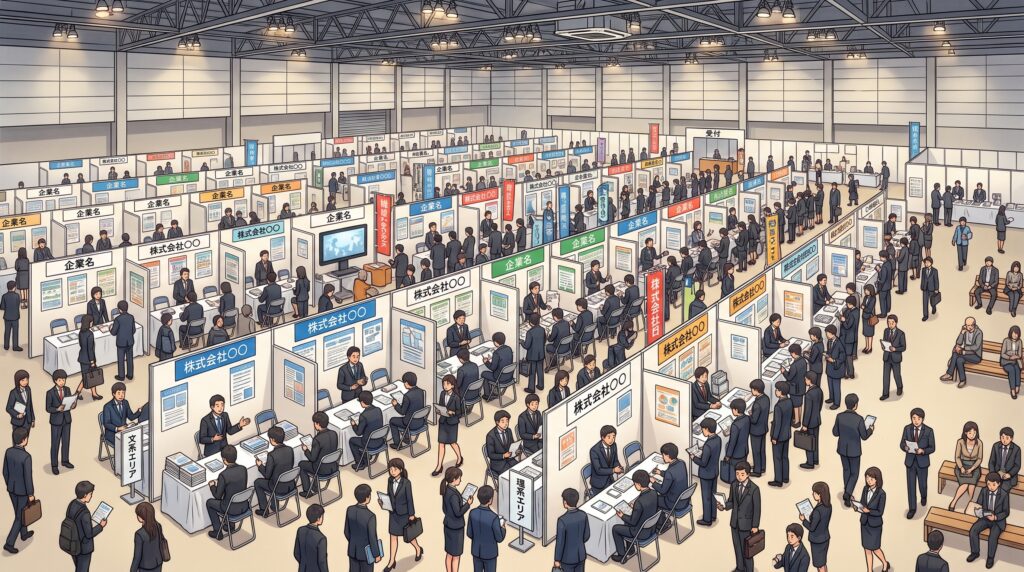
Back then, there were events called shūshoku seminā (就職セミナー, "job seminars"). Companies that wanted to hire new graduates would gather in a large venue, and each would hold its own company information session to recruit university students.
The invitations were sent to students' homes by publishers of job-hunting information. They just turned up, whether you'd asked for them or not. Our seniors, only a few years ahead of us, received piles of them, men and women alike.
But by the time I was job hunting, they had almost stopped arriving for female students. Male students, meanwhile, were still getting them just as before.
I had gone into science at university, so 90% of my classmates were men. So I went to the seminars by tagging along with male friends who had invitations (many of them let up to five people in on a single invitation).
In those days, it was far harder for women to find a job than for men. I took the entrance exams for lots and lots of companies, and finally got an offer from just one, as a systems engineer.
Maternity Leave Existed, but You Couldn't Really Use It
Even back then, maternity leave (産休, sankyū — leave before and after childbirth) was written into employment conditions. But in reality, I think many women quit when they got married or had a baby, because maternity leave was so hard to take.
When I asked about the maternity leave uptake rate at a company information session, one of the executives said this to my face: "Personally, I think women should leave the company and stay at home once they get married."
"Compliance" Was Just a Word
I think it was around the time I joined the company that words like "legal compliance" (法令順守) and "compliance" (コンプライアンス) started to spread through society. But unless it was a large corporation, there weren't many companies you could honestly say actually followed the rules.
I worked as a subcontractor for large corporations. Some of those corporations had a "leave-on-time day" (定時退社日), or "no-overtime day" (ノー残業デー) — "On Wednesdays, let's all go home on time, no matter what" — and on those days, only their own employees went home on time. The fact that they had to create such a day at all shows just how buried in overtime everyone was.
Long Working Hours for Systems Engineers
I've heard that systems engineering is a gruelling job in any country. In Japan, I think it's right at the top of the list.
My company was a small one, with fewer than 50 regular employees.
- Unpaid "service overtime" (サービス残業, sābisu zangyō) was taken for granted
- We could hardly ever take paid leave
- Even when we worked on our days off, we couldn't take a day off in lieu
- It wasn't unusual to do more than 100 hours of overtime in a month
Lots of people ruined their health and left. Because things were like that, after about ten years, my company gradually put systems in place so that women could keep working after getting married — for example, leaving the company once and coming back as a part-timer on shorter hours, or taking work home to do there.

"Young People Today Are So Lucky They Can Take Time Off"
People of the older generation even grumbled about us taking paid leave all in one go: "Must be nice. Young people these days can take a whole week off for their honeymoon. That would have been unthinkable in our day." In the high-growth era, I suppose that really was how things were.
When I left the company, I still had the maximum 40 days of paid leave completely untouched. Even so, I wasn't allowed to use it up before leaving. I was told, "Paid leave is for when you really need it, like when you're unwell. Using it all up and then quitting…" — and this from a company that paid nothing for overtime or for working on days off.
I could go on and on with complaints, but I think companies like this weren't unusual back then.
Frequently Asked Questions
- What is the employment ice age generation? It's the generation who went job hunting as new graduates between the mid-1990s and the mid-2000s — people who are now in their 40s to early 50s.
- Why was it hard for women in Japan to find jobs back then? Hiring had been cut because of the recession, and on top of that, the idea that "women quit when they get married" was still deeply rooted in companies.
Next time: I'll look at how people work in Japan today, and what "work" means to Japanese people.
*I write these posts in Japanese, and Claude (an AI assistant) helps me translate them into English.
How Japan Has Changed, as Told by a Japanese Woman in Her 50s
- Part 1: Work in the High-Growth Era and the Father Who Put Work Before Family
- Part 2: The Employment Ice Age, Job Hunting as a Woman, and Long Hours as a Systems Engineer
- Part 3: Workplaces Changing Under Labour Shortages, and Japanese People Who Keep Working After Retirement
- Part 4: Do Japanese Women Really Treat Their Husbands Like ATMs? School Education and the Rise of Dual-Income Families
- Part 5: From Three-Generation Households to Nuclear Families, Husbands Who "Help" with Housework, and Osechi Today
- Part 6: Caring for My Grandparents at Home, Elderly Care in an Age of Only Children, and Japan's Ever-Evolving Ready-Made Meals ("Nakashoku")
